
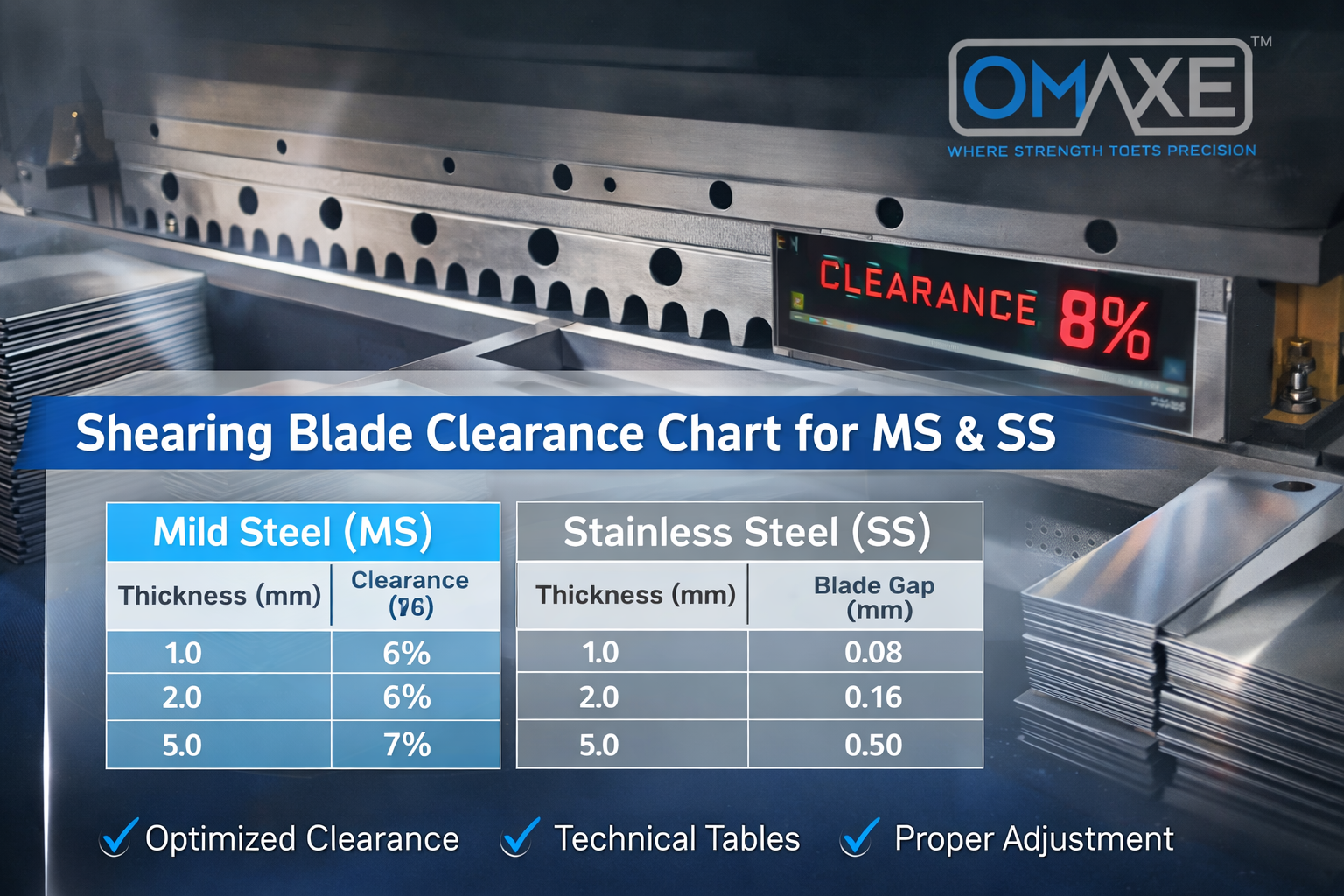
Shearing Blade Clearance Chart for MS & SS
Shearing Blade Clearance Chart for MS & SS
Proper blade clearance is one of the most critical parameters in sheet metal shearing operations. Incorrect clearance directly impacts cut quality, tool life, machine load, and material deformation. This guide explains the correct shearing blade clearance for Mild Steel (MS) and Stainless Steel (SS) with thickness-wise reference values used in industrial practice.
Understanding Shearing Blade Clearance
Shearing blade clearance refers to the controlled gap maintained between the upper and lower blades of a shearing machine. This gap allows controlled fracture of material rather than tearing or crushing. Clearance selection depends on material type, thickness, tensile strength, and machine rigidity.
Why Blade Clearance Matters in Industrial Cutting
Correct blade clearance ensures smooth shearing action, reduced burr formation, minimal edge distortion, and longer blade life. Excessive clearance leads to heavy burrs and angular distortion, while insufficient clearance increases cutting force, causing blade chipping and machine stress.
Shearing Blade Clearance Chart for Mild Steel (MS)
| MS Thickness (mm) | Recommended Clearance (%) | Blade Gap (mm) |
|---|---|---|
| 1.0 | 6% | 0.06 |
| 2.0 | 6% | 0.12 |
| 3.0 | 6% | 0.18 |
| 5.0 | 7% | 0.35 |
| 8.0 | 7% | 0.56 |
| 12.0 | 8% | 0.96 |
Shearing Blade Clearance Chart for Stainless Steel (SS)
| SS Thickness (mm) | Recommended Clearance (%) | Blade Gap (mm) |
|---|---|---|
| 1.0 | 8% | 0.08 |
| 2.0 | 8% | 0.16 |
| 3.0 | 9% | 0.27 |
| 5.0 | 10% | 0.50 |
| 8.0 | 10% | 0.80 |
| 12.0 | 11% | 1.32 |
Stainless steel requires higher blade clearance compared to mild steel due to its higher tensile strength and work-hardening nature. Always adjust clearance carefully to avoid edge cracking and excessive blade wear.
Factors Affecting Blade Clearance Selection
Blade material hardness, rake angle, cutting length, hydraulic pressure, and machine alignment all influence clearance performance. Industrial-grade hydraulic shearing machines allow precise clearance adjustment to match material properties and production demands.
Common Problems Caused by Incorrect Clearance
Improper clearance results in burr formation, twisted sheets, rough edges, blade damage, higher energy consumption, and reduced machine accuracy. Regular inspection and calibration prevent long-term operational issues.
Frequently Asked Questions
Get Expert Guidance from OMAXE Machine Tools


Get In Touch
Plot no.21 ,JK Industrial Park, Dhanya Weight Bridge, Vanch Road, Daskroi, Dhamatwan, Gujarat 382435
info@omaxemachine.com
sales@omaxemachine.com
+91 9924499110
+91 9033378681
Links
PRODUCTS
OMAXE MACHINE TOOLS INDIA PVT LTD